Spotify Isn’t Legal for Your Business —
Here’s What to Do Instead
By Editor, 2025-12-01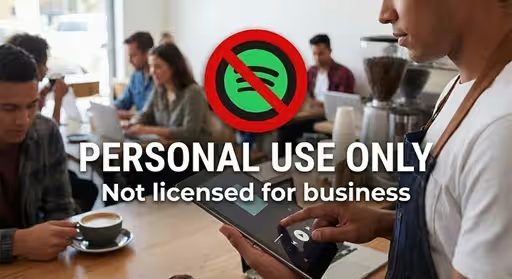
Every day, thousands of business owners make the same expensive mistake: they hit play on Spotify Premium in their coffee shop, boutique, or gym, assuming that their monthly subscription includes commercial use.
It doesn’t. And it could cost you up to $150,000 per song.
This nightmare scenario happened in 2019 at XY Bar in Wichita when performing rights organizations sued them due to playing unlicensed music. They’re not alone. ASCAP filed lawsuits against Chicago bars Fatpour in Wicker Park and Kirkwood Bar in Lakeview, seeking $150,000 in damages — despite annual licenses costing just $2,800 and $1,100, respectively.
The difference between what business owners believe to be legal and what is actually legal has turned out to be a million-dollar trap. Let’s break down why Spotify’s business license isn’t what you think it is — and what you ought to do.
The Hard Truth: Can I Use Spotify in My Store?
Short answer: Absolutely not.
It seems instinctive, but when you pay for a subscription to Spotify Premium, it does not give you the right to use music commercially. Here’s what Spotify’s Terms of Service actually say:
“Subject to your compliance with these Terms, we grant to you a limited, non-exclusive, revocable license to make personal, non-commercial use of the Spotify Service.”
Let’s decode that legal language:
- "Personal" = You, alone, listening
- "Non-commercial" = Not in any business setting where customers can hear it
- "Limited" = Extremely restricted in scope
What About “Spotify for Business”?
Despite popular belief, Spotify does not offer a Spotify for Business or Spotify Pro service. If you search for “Spotify for Business” in the search engine, you won’t find an official solution because it does not exist.
The same limitations are valid for:
- Apple Music
- Amazon Music
- Pandora (personal accounts)
- YouTube Music
- Tidal
- Any streaming service to consumers.
Research indicates that 80% of business owners are not aware that music services are not licensed to be used commercially. If you’re reading this with a sinking feeling in your stomach, you’re not alone.
Real-World Example: Peloton’s $49 Million Lesson
You think you’re too big to be caught? Think again. In March 2019, the National Music Publishers Association sued Peloton in a lawsuit worth $150 million in damages, later increasing this to $300 million in an amended complaint after it was found that they used their music extensively without a license.
Peloton Interactive incurred settlement and litigation costs of $49.3 million to settle a copyright suit filed by music publishers.
Peloton is a billion-dollar organization with huge legal capacities. What chance does a small café or boutique gym have?
How Businesses Actually Get Caught
PROs (Performing Rights Organizations) don’t wait for complaints. They actively monitor businesses through:
- Field representatives who make unannounced visits to establishments.
- Monitoring of social media for business activities and promotion.
- Tips, customer complaints.
- Cross-checking of licensing database.
- Digital tracking of music usage.
When a PRO finds a violation, they contact businesses via phone, email, and mail. If ignored, they send a “Cease & Desist Notice” with five days to respond — after which they sue.
Understanding Music Licensing: Why It’s Complicated
Understanding why Spotify can’t be used for in-store music begins with knowing the fundamentals of music licensing.
There are two types of copyright in every song:
1. Composition Rights (The Song Itself)
Owned by publishers, composers, and songwriters. This covers the music, lyrics, and composition.
2. Sound Recording Rights (The Specific Recording)
Owned by record labels and performers. This includes the specific version of the song that you are listening to.
When you play music publicly, you need licenses for BOTH.
The Four Major PROs in the U.S.
These companies collect and dispense the royalties on composition rights:
- ASCAP (American Society of Composers, Authors and Publishers)
- BMI (Broadcast Music, Inc.)
- SESAC (Society of European Stage Authors and Composers)
- GMR (Global Music Rights)
These companies collect and dispense the royalties on composition rights.
Here’s the problem: Spotify only covers your personal listening rights. It does not pay the higher business music streaming rights fees needed to play in public.
Spotify can only compensate artists a microfinancial amount per stream for individual listeners at home, but cannot fully compensate artists for large audiences of 50 or 100 listeners in a business environment.
Do You Actually Need a License?
Most businesses do. License requirements depend on your square footage:
- Food/drink establishments: 3,750+ sq ft requires licensing
- Other retail businesses: 2,000+ sq ft requires licensing
Limited exemptions exist for:
- AM/FM radio with six or fewer speakers (max four per room)
- Public domain music only (pre-1922)
If you’re using Spotify, YouTube, or Apple Music in your business, exemptions don’t apply — you need proper legal music for commercial use solutions.
Legal Alternatives: What to Use Instead
Commercial use of Spotify alternatives is legal and affordable:
| Service | Monthly Cost | Best For |
|---|---|---|
| Practical Stream | $8.34 per zone | All |
| Soundtrack Your Brand | $25-50 | Retail, Restaurants |
| Cloud Cover Music | $17-35 | Stores |
| Rockbot | $24-30 | Bars, Venues |
All commercial music streaming services provide full legal music for commercial use, copyright protection, and no ads.
The Bottom Line- Illegal use: $11/month + fines up to $7.5 million
- Legal compliance: $8–60/month with zero risk
A Spotify business license doesn’t exist. Proper business music streaming rights protect your business.
Stop using consumer streaming today. Go for legal, licensed platforms.
Ready to Transform Your Venue?
Join thousands of businesses creating the perfect experience with Practical Stream background music.